
BLOG
Welcome to The Blog
The Campus Ministries blog seeks to provide a resource for students during the unprecedented moments of COVID-19. We pray that these words would provide inspiration and be a blessing.
"Fear" - Tuesday, 3/24/20
I was once scammed by a criminal at a point in my life when I was very vulnerable. The incident made me lose sleep, experience massive amounts of stress, struggle with anxiety. Many nights, I slept with a knife by my bed. I bought pepper spray. I went to counseling. It was a tumultuous time in my life clouded by unprecedented fear for my safety and security.
The point is, when this was going on, many people told me to “pray” about it. This was exceedingly frustrating for me because I didn’t know what I was supposed to pray for. Peace? Safety? Rest? Fearlessness? All of the above? Every time I went to pray, I found myself asking God to keep me safe and give me peace. A decent prayer, I suppose. But it never felt like I had solved the problem. I’d open my eyes and un-bow my head and felt just as anxious as before. Am I alone in this struggle?
If you can relate, there is good news: you are not alone. I felt a lot of shame at this point in my life because I felt like when I was afraid, I was sinning. If God commands us “fear not,” over and over again, is my fear a sin against him? Evidence that I don’t trust Him? A sign that I’m a fake Christian?
I don’t think so. The reason I don’t think so is because “Do not fear” happens to be the most frequent command in the Bible. I interpret this as God intimately knowing humans better than we know ourselves: God anticipates that we will fear because it is in our DNA to crave security. In case you don’t believe me, I think this argument is perfectly illustrated by the gobs of people that decided to stock up on toilet paper when they heard the word “pandemic.” It’s the reason that Publix is empty. People crave security. Why? My suspicion is that people detest vulnerability more than anything--more than far-away parking spots, more than surprise quizzes, more than the New England Patriots (a moment of silence for TB). It’s like we’re allergic to it.
This precarious negotiation between vulnerability and security is why God promises to be that security for us. In Joshua 1:9, He states: “Have I not commanded you? Be strong and courageous. Do not be afraid; do not be discouraged, for the LORD your God will be with you wherever you go.” A brilliant solution, Jesus. God doesn’t say that we won’t go through dark valleys and trenches of fear, but He does promise to be next to us the entire time. I also find it significant that God “command[s]” us to be strong and courageous, because it demonstrates that these behaviors do not always come naturally to us. And that’s okay.
In my experience, it’s been valuable to recognize that my fear is my humanity, and peace is God’s divinity that is available to me if I want it. Peace will guard our hearts and minds in Christ Jesus if we ask for it. It doesn’t mean that we’ll never fear again. And, most importantly, what I want you to know is that if you find yourself afraid amidst the crises in the world, I don’t think that God’s first instinct is to scold you for not being at peace. I think God, more than anything, craves the opportunity to quell your fears with his presence. It’s a discipline to be at peace. Give yourself space today to recognize that and pursue God’s peace daily as we navigate these unprecedented times.
Philippians 4:7 “And the peace of God, which transcends all understanding, will guard your hearts and your minds in Christ Jesus.”
"Anxiety" - Wednesday, 3/25/20
Yesterday, we reflected on fear. Today, we’re looking at anxiety. Both of these feelings have been washing over me more frequently in the last few weeks than is normal.
Anxiety, from what I have experienced, seems to be a bit more vague than fear. Fear is often directable. You can usually pinpoint what you’re fearful of. Anxiety, however, typically renders me speechless, and I find myself unable to articulate why I’m anxious or what I’m anxious about. This is what makes it so frustrating for me.
I studied English in undergrad, and I took a few classes on 19th century literature. One of my favorite texts we read was Charlotte Perkins Gilman’s iconic piece “The Yellow Wallpaper.” This is not a text I’d recommend reading right now, because it’s stressful to read and probably a little too close for comfort. TL;DR version is this: the speaker is quarantined because she is plagued with what analysts suggest is postpartum depression. As the story unfolds, the speaker becomes more and more unreliable because she is losing her mind being locked in a room with, you guessed it, yellow wallpaper, that haunts her as she has nothing else to do but obsess over it.
In those days (published in 1892), postpartum depression was not widely understood or recognized, so the text suggests that her husband (not the most likeable character in the story) has decided that because she is ill, she must stay in the house, in this room with the yellow wallpaper, and takes none of her anxieties seriously because he is convinced she is crazy. To be fair, she is kind of crazy. Which brings me to my point: anxiety, especially if left unaddressed or suppressed, can often make us feel as though we are going crazy.
Similar to the speaker in “The Yellow Wallpaper,” I have found myself staring at lightswitches or obsessing over the “Y” key on my keyboard for no apparent reason. Unsimilar to the narrator, I’ve only been quarantined for about a week and a half now, and yet still I feel myself going a little crazy. Are any of these behaviors feeling oddly similar to you?
In Jesus’ words, our hearts are troubled. Yet He encourages us: “Do not let your hearts be troubled. You believe in God; believe also in me. My father’s house has many rooms; if that were not so, would I have told you that I am going to prepare a place for you?” (John 14:1-2). This demonstrates two things:
- Jesus cites our heavenly home as the ultimate reminder of hope. He doesn’t say, “Don’t let your hearts be troubled. The world is a great home and so suck it up.” No, in asserting that His father’s house has many rooms, he reminds us that this world is not our home. It is fretting over the conditions of our hotel when our home is being renovated. Understandable--we’re currently living in the hotel, after all, but ultimately, not useful.
- Jesus is the one doing the preparing. In a world where the news reads COVID-19 24/7 and we’re bedridden even if we’re well, it can be maddening. But we have the privilege of surrendering control. Which is good news because at this point, we need divine assistance. Jesus is the architect. He was, and still is, preparing a place for us.
"Doubt" - Thursday, 3/26/20
A few days ago, I was calling my best friend (I have had lots of time on my hands) and we started talking about literature. (Sorry, this is day two about literature but I can’t help it.) She mentioned her frustration with the insistence of the literary community that authors intentionally leave “easter eggs” for the reader to discover. For example, she said, in her favorite book, A Tale of Two Cities, she remembers a lot of comments in her class discussion about the brilliant foreshadowing and symbolism of the tiniest details. Have you heard English teachers wax passionately, “The blue curtains symbolize deep sadness,” or “The tiles in the floor represent a fractured understanding of reality...glued together haphazardly to become beautiful”? It all seems a bit dramatic, doesn’t it?
My friend pressed me, “Come on, Lindsey, do you really think that even the brightest poets and authors meant to hint at all these hidden meanings? Or do you think that it’s possible that these were accidental easter eggs? That we’re, pun intended, reading too much into them?”
I responded to my friend with this argument: I’m sure some of these symbols are coincidental. (I actually think these rare accidents are miraculous, rendering the art of writing extremely spiritual. But anyway.) However, accidental or intentional, I think it is always valuable for people to engage with the text. Whether a snarky sophomore doesn’t buy that Emily Dickinson capitalizes “funeral” in “I felt a Funeral, in my Brain,” in order to elevate death (she was kind of obsessed with death) is not the point: at least the student is asking questions and engaging with what Dickinson wrote. In my opinion, that’s the valuable part.
I think that doubt plays a similar role in faith. I believe that faith is living, breathing, and dynamic in our lives that changes day to day. Engaging with the Bible is more important than reading it. Serving others is more important than thinking service is valuable. Jesus knows that we are not creatures of stillness--that’s why he has to command us to “be still and know that [He] is God” (Psalm 46:10).
Therefore, if healthy faith is living and breathing, we must engage with it daily to keep it alive. And sometimes, that means asking questions that make us feel like “bad Christians.” I believe that Jesus desires transparent conversation over polite conversation. God begs throughout the Bible for us to lean on Him for support: “Cast your cares on the LORD and he will sustain you” (Psalm 55:22). If you had a friend who was struggling with something, would you rather him or her give the cookie-cutter, cotton-candy answer of “fine” when you ask how he or she is? Of course not! You would want to know the truth. How silly it is, then, that even when speaking to the omniscient creator, knower of our hearts and minds, that we attempt to hide the uncomfortable truths from Him.
So, in the middle of crisis, ask God questions. He can handle it. Ask Him questions and listen for answers. And if you can’t hear His answer, keep asking anyway.
"Solitude" - Tuesday 3/31/20
Now more than ever, I suspect that each of you have begun to more intimately know what terms like “solitude,” “quarantine”, or “isolation” mean. Today, we’re going to talk about solitude.
It’s funny that I would be writing about solitude. On the Myers-Briggs personality test, I regularly test 100% extroverted on their spectrum. I’m being very honest when I say that I never prefer solitude over being with people. So quarantine, for me, is a personal nightmare.
Solitude teaches us things, though. Here are a few pros and cons that I have observed. (I’ve had a lot of free time to think about it.) I’ll leave a blank space for you to engage with these observations and reflect.
- Solitude is vulnerability. This is typically true, right? As a female, I feel the truth of this statement regularly as I am walking to my car in a dimly lit parking lot or go jogging by myself. Without other people, I have little protection. How funny it is that in this COVID-19 crisis, it is actually safer for us to be alone. In my most fearful moments, I have to remind myself to turn to God for comfort. This isn’t always easy.
- How have you experienced vulnerability in your solitude? ___________
- Yet, solitude produces confidence. When you’re forced to be alone, if you rise to the occasion, it can ultimately make you more comfortable being alone. I live alone for the first time in my life, and it has taught me many things about how to protect myself so that I can survive (and thrive) independent of other people. This has given me immense confidence in my ability to be by myself. Furthermore, the Bible instructs us to have confidence, above all else, in God: “I have confidence in your strength; you are my refuge, O God” (Psalm 59:9).
- How have you experienced confidence in your solitude? ___________
- Solitude is unawareness. Because being alone gives you no frame of reference, it’s easy to become unaware of anything and everything. Today we have the Internet to keep us informed, but true solitude can compromise our ability to stay informed with the current state of our world. In these moments, I’m grateful that God is omniscient. Even in the most aware states of the human conscious, God knows all.
- How have you experienced unawareness in your solitude? ___________
- Yet, solitude produces clarity. Being alone gives us the unique opportunity to reflect, and I hope that this blog has been giving you a space to do so. Being separated from influence teaches us about ourselves and often can teach us a few things about what our true desires and convictions are. Jesus practiced solitude regularly. Luke 5:16 tells us, “But [Jesus] would withdraw to desolate places and pray.” I can only surmise that at least part of Jesus’ motivation for being alone was to gain clarity.
- How have you experienced clarity in your solitude? ___________
- Solitude can be lonely. I say “can be” because I hear from my introverted friends that solitude is quite energizing. I’m guessing, however, that solitude for too long would feel lonely for most of us. God says in the creation account “it is not for man to be alone” (Genesis 2:18) because He knew that we need each other.
- How have you experienced loneliness in your solitude? ___________
- Yet, solitude produces independence. If we become comfortable being alone, we develop a healthy independence. Though we need each other, I also think that independence is invaluable because it teaches us to “walk humbly with our God” (Micah 6:8), for though we may be alone on earth, we are never separated from our Heavenly Father.
- How have you independence clarity in your solitude? ___________
"Loneliness" - Wednesday, 4/1/20
Loneliness is likely something we all experience from time to time. In today’s quarantined world, I know I am especially susceptible to loneliness because I’m not near people.
When I turn to the scriptures, it’s comforting to know that I am not alone. The Psalmist laments in chapter 25: “Turn to me and be gracious to me, for I am lonely and afflicted” (Psalm 25:16). King Solomon reflects on the maddening state of loneliness in Ecclesiastes:
“Again I saw something meaningless under the sun: There was a man all alone; he had neither son nor brother. There was no end to his toil, yet his eyes were not content with his wealth. 'For whom am I toiling,' he asked, 'and why am I depriving myself of enjoyment?' This too is meaningless—a miserable business!” (4:7-8).
This passage reveals that loneliness has been a struggle across humanity for millenia. Does this comfort you at all?
Solomon continues:
“Two are better than one, because they have a good return for their labor: If either of them falls down, one can help the other up. But pity anyone who falls and has no one to help them up. Also, if two lie down together, they will keep warm. But how can one keep warm alone? Though one may be overpowered, two can defend themselves. A cord of three strands is not quickly broken" (Ecclesiastes 4:7-12).
We are not as easily broken when we are a “we.” Solitude has benefits but, ultimately, I believe we were made to be together.
The question then becomes, what do we do with loneliness? I propose two things:
- Reflect on why you are lonely. Is it because of quarantine? Or, have you been lonely for awhile? Reflect on these questions--I encourage you to write down your responses.
- Is feeling lonely a recent development in my life?
- Do I ever feel lonely even when I’m surrounded by people?
- If so, why do I feel that way?
- Am I afraid of something that being alone forces me to confront?
- Have I ever reflected on my loneliness?
- Have I ever told anyone about feeling lonely?
- Reach out. This one may be a little more daunting, but it’s crucial to share how you’re feeling for a few reasons: 1) it forces you to acknowledge your feelings and 2) serves as practice in giving language to the way that you feel. Thirdly, 3) it makes you understand that you are not the only one. How funny it is to acknowledge the fact that YOU ARE NOT ALONE IN FEELING LONELY.
Step one is working on yourself with yourself. Step two is working on yourself with the help of others. Both are crucial, both are necessary, and both are difficult.
If you think that you have no one close to you that you can share your thoughts and emotions with, let the Southern Adventist University chaplains serve you. Our prayer request line is (423)-281-8996, feel free to text it any time with needs or concerns. Chaplain Anna Bennett is a remarkable comforter, advice-giver, and listener. If you’re interested in setting up a virtual appointment with her, email annabennett@southern.edu You also can reach out to our Instagram page @saucampusministries if that’s your preferred medium.
I pray for peace, comfort, and strength to you as you journey with all of us to battle loneliness in a time when we are all acutely vulnerable to it.
"Community" - Thursday, 4/2/20
Acts 2:42-47:
They devoted themselves to the apostles’ teaching and to fellowship, to the breaking of bread and to prayer. Everyone was filled with awe at the many wonders and signs performed by the apostles. All the believers were together and had everything in common. They sold property and possessions to give to anyone who had need. Every day they continued to meet together in the temple courts. They broke bread in their homes and ate together with glad and sincere hearts, praising God and enjoying the favor of all the people. And the Lord added to their number daily those who were being saved.
I want you to meditate for a second on all of the words I bolded in the paragraph above. So many words of inclusivity, togetherness, and unity. It sounds like a utopia. And in many ways, community is a utopia: a kind of paradise that supports, protects, and empowers.
As I have mentioned before, I am an extrovert to my core. And I’ll admit, reading through Acts’ account of the early church makes me feel thoroughly vindicated for my preference. There is no question that community is an integral portion of every person’s wellbeing.
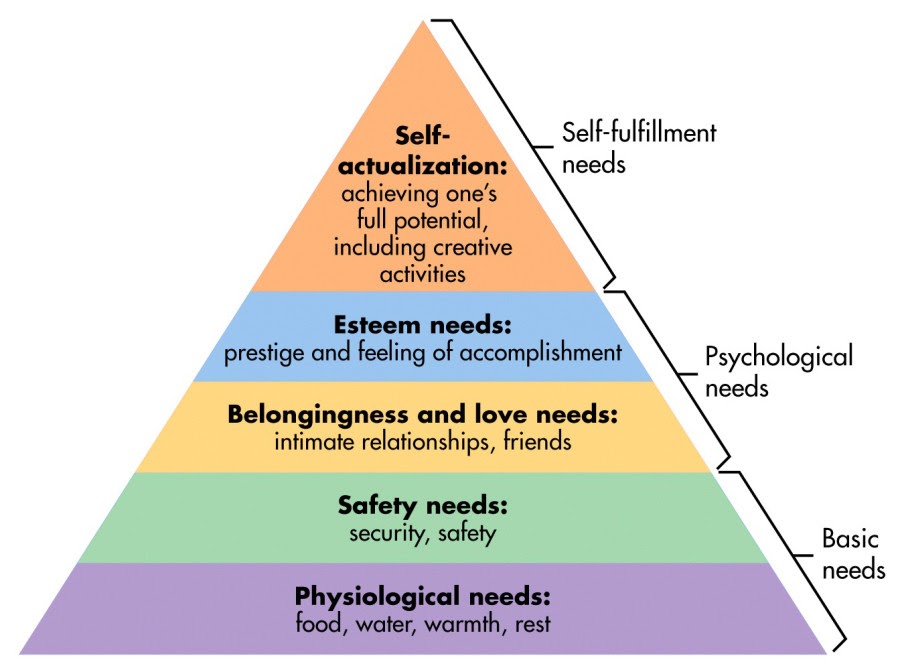
If you’re at all familiar with Abraham Maslow’s hierarchy of needs, you’re well aware that the third most important need established is a need I would argue is met through community. It’s remarkable that this need is so urgent it ranks only after physiological and safety needs. Maslow asserts that after the priorities required to stay alive, the next most important need is to feel belonging.
It’s no surprise, then, that the early church’s model was wildly successful. Explosive growth was one of the notable characteristics of this community. This is corroborated not only by the biblical narrative (“And the Lord added to their number daily those who were being saved” Acts 2:47), but also by historians.
Community is a blessing. And the wonderful thing about community is this: we don’t have to be together to have community. Who would argue that the group of women who came forward a few years ago by hashtagging #metoo are any less a community than our local church congregation? If it supports, protects, and empowers through intimate relationships and empathy, I believe it is a sterling example of community.
If a community isn’t contingent on proximity between its members, then we have the opportunity to be a community during COVID-19. Here are a few action steps that I would encourage you to pursue to keep our Southern community thriving despite the nature of our circumstances:
- Text a friend.
- Call a (different) friend.
- Facetime a(nother) (different) friend.
And just talk. Talk about funny things, about serious things, about TikTok or candle scents or the economy, but talk. Journey together.
If you’d like someone to journey with you, email chaplain@southern.edu or reach out via our Instagram: @saucampusministries
"Student Spotlight: Aly Cole" - Tuesday, 4/7/20
Hello, friends!
My name is Aly Cole and I am a 3rd year here at Southern. I actually work for Campus Ministries as the Vespers Coordinator and because I live in the Collegedale area, I am still helping to program the weekly Vespers programs. I am thankful for the position first because it gives me something extra to do with my time, and second, it almost forces me to maintain a community. Because I am an introvert, I generally don’t mind being by myself. However, I am also prone to sink in depression when I don’t reach out and engage in a community.
And to be honest? The third week of quarantine was pretty rough. My boyfriend Danny left to go back to Maryland the week before, school started again, and it hit me that “Oh wait… this is actually real?” I didn’t engage in the community of friends that I know I still have. I didn’t talk to my family about my disappointments, anger, frustrations or confusion. I didn’t want to talk to my boyfriend about it either because I figured if I admitted things were hard for me, then it would just make long distance harder. So, I did what I do best: shove all of my feelings deep, deep down into myself where no one can reach them. My prayer life for the last few weeks has looked like “God help me be productive tomorrow, be with everyone who is sick and please help me and Danny with long distance.” I told no one--not even God--that I was hurting.
Last week I went on a virtual walk with Pastor Anna. We both went on a walk at the same time while also talking on the phone. God just has a way of getting right to the heart of how I am feeling when I talk to a mentor like her.
**Southern did a really kind thing when they assigned us to faculty and staff members - reach out to whoever you were assigned to and be honest with them about how you are doing good or bad.**
When I talked to someone outside of my own personal situation about how I was honestly doing, I got some perspective: “It’s okay to be upset, Aly. You don’t have to have it all together right now. You are allowed to tell God that you are angry, disappointed, confused and upset that things are now vastly different than what you had planned.”
So, here I am. Being honest with myself that I am not happy with how things are going right now. How I wish things were different--how I actually MISS living in the dorm. But instead of ignoring my feelings and shoving them deep down where not even I can reach them, I have decided to start allowing myself to feel hurt. And once I allow myself to feel the things I am feeling, I can begin to move past them and see the good in this situation and acknowledge the growth that God has planned for me. Yes, I am sad. And this sadness will not last forever. God has so much more planned for me - even during the quarantine.
Dear students at Southern, when troubles of any kind come your way (like coronavirus) consider it an opportunity! Be assured that this test of faith produces a kind of spiritual maturity and inner peace which nothing else can create in you. And allow this exercise of endurance work within you, so that you may be even more developed and complete in your faith, lacking nothing.
(James 1:2-4)
"Student Spotlight: Casey Goldring" - Wednesday, 4/8/20
It’s interesting to reflect on the way I’ve been responding to the news the past two weeks. Initially, my emotions were pretty volatile. I felt as if I were falling and scrambling in a panic to cling on to anything that was stable. I had super low lows whenever one of my carefully thought-out plans had to be cancelled. I cried for my friend’s postponed graduations and weddings. I mourned for the people who weren’t able to say proper goodbyes before leaving school. My heart broke for all the student missionaries whose experiences were cut short. Things were changing left and right, moment by moment. In fact, right before reading the email that we were to leave school, I had just gotten off the phone with my dad. I had told him, “Right now, I’m just going to pack up some textbooks before driving to see Ben. I’m sure things will be fine.” (Ben is my boyfriend.)
I like being in control of my situation, and this is definitely not one I can control. As much as I love to, I can no longer set dates on my calendar and make future plans. I have to let go and live moment by moment. That may be a lifestyle for some, but this has been a huge adjustment for me. All the routines I had practiced and perfected suddenly seemed empty and meaningless as I drove back home.
Since I’ve been home, I’ve found a sense of relief in these newly cancelled plans. I’m no longer in an anxious limbo, asking myself, “am I still going to see them?” and “are we still going there?” The answer is no, and I’m finding comfort in that. This will pass, and those dates will resurface, but now is not the time to meticulously plan ahead. There are more important things on my list, like finding joy in this new reality and trusting my Creator and His heavenly plan.
I’ve been clinging to the promise in Romans 8:31 that says, “What, then, shall we say in response to these things? If God is for us, who can be against us?”
I am not a victim of God’s punishment. I am not being sent to my room to think about what I did (contrary to some memes I’ve been seeing lately). This is just another situation that I will live through with intention, holding fast to the understanding that the God of the universe is on my side. He sees me. He’s clinging to me. He goes before me to fight battles that I am blissfully unaware of. In Philippians 4:7 He promises us peace that surpasses all understanding--peace we don’t need an explanation for, but have the privilege to bask in while we navigate these uncertain circumstances.
With this mindset, I can find joy. Despite cancelled plans and an empty calendar, every day is full of opportunities to grow, connect, and learn new things. Lately, my joy has looked like this:
- Painting and writing letters
- FaceTiming friends
- Perfecting my morning cup of coffee
- Picking up my guitar for the first time in months
- Taking long walks and enjoying the sunshine
- Baking and cooking new things
I can’t simply press a button to rid myself of anxiety, but I can lean on my Creator, my Sustainer, and my Friend. He is present in this moment and the next, and will continue to be present long after life returns to normal. His promises are sustaining me and I know He is on my side today and everyday.
"Student Spotlight: Danny Yonkers" - Thursday, 4/9/20
Danny Yonkers, one of the LifeGroup leaders on our Campus Ministries team, was interviewed for today’s Student Spotlight.
Q. What has been frustrating for you?
A. Honestly frustrating is most of what this situation is...I had to leave a life I have been building for three years and come back to my home where I never have truly felt safe or happy in that retrospect. I miss everyone and I am in a place that I REALLY do not want to be.
Q. What has been hopeful for you?
A. The hopeful things are great, I have a life group that meets every Tuesday and it isn't even people that only go to Southern but we are all in the same boat of our world getting flipped upside down. I also really like talking and spending time with my friends from facetime and zoom.
Q. How do you feel when you watch the news?
A. I don't really watch the news... I read it just because I find watching other people report it frustrating and a waste of my time compared to me reading it at my own pace. I feel sad when I look at the news because I fear that we will not be back for school in the fall due to this pandemic.
Q. How do you feel when you pray? Read your Bible?
A. When I pray I feel constantly distracted, and I try my best to stay focused but the change just gives so much to think about and there are so many distractions in the house. I bought a journal to try that but it is still on its way from Amazon.
Q. What is the scariest thought through all of this?
A. I think the scariest thing for me is just the fact that I have to self-pace myself through school and figure out a whole new system to passing nursing school. I guess another thing I am worried about is whether or not I will be able to work for summer camp because I would rather be anywhere besides home, and I feel like a lot of students can resonate with that as well.
Q. Is there a Bible verse that has been meaningful to you?
A. I have been reading through Matthew and I am currently at the part where Jesus is asking Peter to step off the boat and trust that Jesus will carry him on the rough waters. But when Peter loses focus he begins to sink, and I feel like that is me right now. It gives me a want to turn my faith back to Jesus rather than myself. (Matthew 14: 28-33)
"Help!" by Tiffany Bartell - Tuesday, 4/14/20
As a counselor here at Southern, I am often on the receiving end of many calls for help. Sometimes that looks like a student setting up a therapy appointment to work through a specific issue, sometimes it looks like answering a call from a concerned dean, and sometimes it looks like someone coming in because they are at the end of their rope and not sure of what to do.
With COVID-19 creating chaos in the world, many of the conversations I have been a part of have centered around how to cope with anxiety, loss of community, loss of plans and loss of routine. Loss seems like a common theme and when it contains so many layers it can be hard to know which way is up so that you can even reach out for help!
I am a very visual person and so for me the picture that really resonates with me is that of COVID-19 taking us all and pitching us off of this big boat called “academic life” and tossing us into the ocean. So confusing at first: everyone is trying to find the surface and we all are looking for that floatation device to secure ourselves as we wait for this storm to pass and get our feet on dry ground again.
So! What is that floatation device? It’s help. There are four main ways that we can find help in tough situations:
-
The first is to ask for support from friends and family. The good news (and the bad news!) is that we are literally all in this together! Especially right now, the whole world is going through this at the same time and we have never needed each other more than we do today. Verbally processing how you are feeling or normalizing your reaction to the changes can be so helpful and who better to do it with than those who know and love you best and might be feeling the same way.
-
The second way to ask for help is to reach out to God and tap into His unfailing love and strength. Psalm 36:5 says, “Your love, Lord, reaches to the heavens, your faithfulness to the skies” (NIV). He is truly the one who has the power to protect and care for us during these times and He is the only one who can see past the deep waters we are in to the other side.
-
The third way to ask for help is to reach out to your Campus Ministries staff or one of the counselors in Counseling Services. We are here to support you, encourage you, listen to you and walk through this valley with you. Sometimes it is helpful to reach out to someone whose job it is to hand out life preservers! There is no part of life, while you are at Southern, that you have to do alone. We are here with you through each moment. Zoom sessions can be scheduled with both offices. Reach out!
-
The last way to help yourself through difficult situations is to look for someone else to help. Helping someone else with their burden is a tried and true way of lifting yourself up as well. We are wired for community and connection and it is in the asking and giving of help that we feel most intimately connected to each other.
My favorite verse is found in Psalm 18:19 and reads, “When I was fenced in, you freed and rescued me because you love me” (CEV). It is God’s delight and pleasure to help you in all of the situations you encounter and we love and care about you too. It’s more than okay to ask for help and there are resources and support to meet you on the other side of your request. Take care of you.
"'Hope' is the thing with feathers" - (314) by Emily Dickinson - Wednesday, 4/15/20
- “Hope” is the thing with feathers -
- That perches in the soul -
- And sings the tune without the words -
- And never stops - at all -
- And sweetest - in the Gale - is heard -
- And sore must be the storm -
- That could abash the little Bird
- That kept so many warm -
- I’ve heard it in the chillest land -
- And on the strangest Sea -
- Yet - never - in Extremity,
- It asked a crumb - of me.
For those of you unfamiliar with Emily Dickinson, she is the queen of skepticism. Constantly calling the cornerstones of human existence like people, love, religion, and God into question, the poet was certainly familiar with doubt. She wasn’t afraid of it. Yet in this poem, even Dickinson is charmed by the phenomenon of hope. She puts it in quotations: “‘Hope’ is the thing with feathers,” comparing it to a melodic bird that “perches in the soul.”
I wanted to give this poem to you today to chew on for awhile as we begin this discussion on hope. What a topic to put in quotations. Do you have hope today?
I’ve mentioned the Psalms many times because I read the book as part diary and part poetry (a great intersection for me). They’re chapters filled with clumsy praises and violent laments of a real life human. And it’s because I’ve read the raw stuff that I know the flowery stuff is honest. When David says “Praise the Lord, my soul; all my inmost being, praise his holy name” (103:1) you know that he means it. Because David had the unique talent of talking to God transparently, like a friend. Perhaps this is why David has been labeled a man after God’s own heart.
Psalm 131 is begins with a distinct command: “O Israel, put your hope in the LORD-- Now and always” (131:3). There’s that word again: hope. The word that is translated as “hope” is originally “yachal,” a Hebrew word. Yachal actually is defined by not only our word today of “hope,” but perhaps more accurately “to wait” or “to expect.”
This image of hope is illustrated by Hillsong Worship’s beautiful song “Seasons”:
- “Like the frost on a rose
- Winter comes for us all
Oh how nature acquaints us
With the nature of patience
- Like a seed in the snow
- I've been buried to grow
For Your promise is loyal
From seed to sequoia”
This song is really quite remarkable. My favorite line in the song comes later, however, when the music goes into the bridge, building more and more until it comes to what I consider to be the thesis of the song: “[I]f You're not done working, God, I'm not done waiting.”
Do you feel like you’re waiting on God? Does this waiting make you feel hopeful or hopeless? Give yourself space and time to reflect on this before we continue.
This same word, yachal, is also used in Genesis when Noah and his family survive the great flood and are waiting in the ark for signs of the earth growing again:
“After forty days Noah opened a window he had made in the ark and sent out a raven, and it kept flying back and forth until the water had dried up from the earth. Then he sent out a dove to see if the water had receded from the surface of the ground. But the dove could find nowhere to perch because there was water over all the surface of the earth; so it returned to Noah in the ark. He reached out his hand and took the dove and brought it back to himself in the ark. He waited seven more days and again sent out the dove from the ark. When the dove returned to him in the evening, there in its beak was a freshly plucked olive leaf! Then Noah knew that the water had receded from the earth.""He waited seven more days and sent the dove out again, but this time it did not return to him” (8:6-12).Applying our understanding of the word “yachal,” we can deduce that Noah not only “waited” seven more days, but he hoped for seven more days before he sent the dove out. Sometimes hoping feels more like waiting than hoping.
But I think the difference between waiting and hoping is the other definition “yachal” gives us: to expect. If we wait with no expectation, it is truly just waiting. But waiting with expectation that God will do something remarkable--that is hope. And sometimes, we’re called to wait, to expect, to hope, all at once. But as the song reminds us, if God is not done working, we must continue to wait.
How does waiting on God make you feel? If you’d like to unpack this with someone virtually, email chaplain@southern.edu to set up an appointment.
"A Meditation on Healing" - Thursday, 4/16/20
I’d assume that “healing” is somewhat of a buzz word right now. The condition of our health is on the front lines of everyone’s minds, I’m sure. My prayers have often featured this word lately, earnestly begging God to rid the earth of COVID-19 as thoroughly as he did with the flood in Genesis.
But healing is an elusive thing sometimes. This unfortunate reality was illustrated clearly to me when my Auntie Karri, a woman who shaped me, mentored me, loved me, and knew me like no one else, was diagnosed with stage four lung cancer two years ago.
I didn’t know how many stages cancer had before Auntie Karri. I remember having to Google, “How many stages are there in cancer?” just to gauge how far along she was. As I hit “enter,” I remember in the split second it takes Google to retrieve answers, I thought about the rhetoric I’d heard surrounding cancer before. I didn’t remember hearing more than four stages. But I tried to convince myself, repeating out loud “stage five lung cancer,” to see if it sounded familiar. As the page loaded, my hope of the phantom “stage five” cancer being real was murdered in cold blood. There were only four stages. She was in the last stage. The next stage would be death.
A funny thing happens upon diagnosis: you immediately begin weighing outcomes. No matter how damning the diagnosis is, you still evaluate how reasonable it is to hope. Sometimes, you conclude: completely unreasonable. Sometimes, you coax yourself into a coma of optimism. You need evidence for this optimism, of course, so you pester and prod at the doctor who gave the report, asking for statistics, data, percentages, personal testimonies.
And when the doctor gives a particularly grim diagnosis, encircled by tragic probabilities, I think that people typically respond in two ways. They can continue to hope, or they can give up. Either way, we must adjust.
I don’t think that adjusting is necessarily the antithesis to hope. Adjusting simply means that you’re acknowledging reality and accommodating accordingly. When my aunt died, I didn’t adjust. I kept dancing through life as if I hadn’t heard terrible news, as if I weren’t burdened with the thoughts of this catastrophic potential. And because I didn’t adjust, I didn’t spend the time with my aunt I now wish that I had. Because spending more time with her than I had before, well, that would mean that I was acknowledging the “c” word: cancer. And if I acknowledged cancer, I was surrendering to the idea of her death. Or, so I thought.
In these moments I remember listening to the song “Resurrecting” a lot. One of Elevation Worship’s biggest hits, these lyrics both haunted me and comforted me. I digested each syllable with intensity and consistency, as if my devotion to the song would cure Auntie Karri’s lungs. The most potent part of the song was in the bridge: “The resurrected king is resurrecting me.” I am a Christian, I thought, and therefore, I believe that Jesus can heal people. There are stories about it in the Bible. So, I concluded, this wasn’t an outlandish prayer request. Besides, I’ve always thought of God listening to our prayers like a bad boy being challenged to an arm wrestle: ignited at the provocation and chance to prove himself powerful. Maybe this is bad theology. Maybe not. I figured that God likes when we ask unreasonable things, so I asked Him to heal my aunt.
He didn’t. He gave us nine months with her. The exact amount of time it takes to grow a life in the womb, he had taken Auntie Karri away from us. Was he too busy? Knitting together someone else’s pregnancy? Was he angry? Did I pray wrong? Did she?
Ironically, the person who had the most optimism through the entirety of the great cancer tragedy was my aunt. I understood differently the memorized proverb, “A cheerful heart is good medicine” (17:22). Still, not good enough medicine to heal her completely.
Honestly, I don’t have an answer for this blog’s questions, and there are many questions. My relationship with the word “healing” is skeletal and skeptical. I know God can heal people, and so I pray for healing. But I’m still grappling with the great gamble God seems to make: why certain people are cured from stage four cancer and why others aren’t afforded the same treatment.
Do you resonate with this? In the midst of COVID-19, what’s your relationship with healing? Maybe you’re hopeful, I hope that you are, but if you’re not, you’ve got a community with me and many others. I have a tethered, complicated, and unstable relationship with healing. If you do too, welcome to the club.
If you’d like to further unpack your response to this post or talk about any other responses to COVID-19, please email chaplain@southern.edu
"Breath" - Tuesday, 4/21/20
On top of the COVID-19 crises that have plagued our globe over the past few months, those of you who attend Southern have another crisis to meddle with your mind: the Chattanooga tornado that swept the town last week.
The tornado has yielded many catastrophic results for many of you--I’ve followed the viral posts and letters to the administration. There’s no question that as classes resume this week it will be difficult for us to resume ourselves. I’m guessing you’re already struggling with how to navigate the unprecedented Vitamix that has represented our lives for the past few weeks: quarantine, social distancing, fear, watching the news, reading about New York, it’s all enough to make a person absolutely lose his or her mind. If this is you, you are heard, seen, and understood.
As DisneyPlus launched a few months ago, I found myself revisiting old, iconic childhood cornerstones. One film that I was particularly drawn to was the classic 2003 Disney film Finding Nemo. I won’t give any spoilers here, but I will cite the ever-shining Dory in one of my favorite lines from the film: “Just keep swimming.”
If you’ve seen the film, you know that Dory doesn’t simply say “just keep swimming” and then move on. Dory sings this line--chants it, even--repeating it over and over as she dances enthusiastically through the blue water.
Mantras are a good thing. They’re good because in crisis, meaning sometimes leaves us. When I am held captive by severe anxiety, I say to myself “breathe” over and over and over again. In these moments, I’m not undone by the deep, metaphorical miracle of breath and how it represents life. Nor am I stirred by the impressive carbon dioxide to oxygen conversion that my body was born doing, never being taught. “Breathe” in these contexts is a command. A direct, easy to understand, concrete imperative: BREATHE. And in crisis, this is what we need.
The “breathe” incantation is one that I’ve heard from psychologists and counselors. It’s a nifty trick. And it’s accessible. It’s one word, one syllable, one thought. And in moments of crisis, sometimes it’s all I have.
Later, when I’m calm, I can reflect and meditate on breath. But in crisis, it’s responding to the command that’s important. So, what’s your command? What’s the panicked thought that flashes through your mind in the middle of disaster? What’s the organic chant that arises in your psyche when you enter fight-or-flight?
If you’re feeling in crisis right now, tell yourself to breathe. Close out this browser, sit somewhere calm, quiet, safe, and breathe. Then tackle other things. First, practice the sacred art of keeping yourself alive: inhaling and exhaling.
If you’re not feeling in the crisis mode, join me in a short meditation on breath. Breath is much more central to the gospel than I think we often give it credit for. Because breath is, literally, the name of God. I’ll explain.
Perhaps you’ve heard of the holy Hebrew name for God: Yahweh. The name Yahweh, revealed to Moses as YHWH, is made up of aspirated consonants. When spoken, it is the sound of breath. This is significant because it informs us about God’s character. Etymologically, Yahweh comes from the verb “I am” or “to be.” I’ve read Hebrew scholars who translate Yahweh as “the one who causes ‘to be’”. This is no surprise to us, is it? Our very origins reflect this divine omnipotence: God created humankind by breathing life into lifeless bodies:
“Then the LORD God formed a man from the dust of the ground and breathed into his nostrils the breath of life, and the man became a living being” (Genesis 2:7).
We were certainly created (with breath) to breathe. Breath may be your emergency memorized line or a thankful prayer to the Almighty Yahweh. And as I have been at risk for sounding like a fitness instructor for a few paragraphs now, I’ll leave you with something I’ve heard many times in spin class that centers me and gives me energy: focus on your breath today.
"Rest" - Wednesday, 4/22/20
Rest may be evading you lately. And that’s okay.
I’m no expert on how to sleep well. And from what little I do know, I think it’s probably different for everyone. What I do know for sure is that rest is a command in scriptures. What a relief, right?
I refer to the story of creation probably too much. If you’ve been faithfully reading the blog, you can attest to this. But I refer to it because I think it’s a good barometer for perfection. How did God want the world to operate? What were his original ideas for his creation? One thing is certain: God made rest a priority from the beginning of time:
“By the seventh day God had finished the work he had been doing; so on the seventh day he rested from all his work. Then God blessed the seventh day and made it holy, because on it he rested from all the work of creating that he had done” (Genesis 2:2-3).
God actually assigned one full day--a 24-hour rotation of time--to rest. What’s more astonishing is that he seems to practice this rhythm himself. He rested on the seventh day. This part is especially meaningful to us, Seventh-day Adventists, because this passage is largely where we get our identity as a denomination from. It is a beautiful thing and I believe we should celebrate it.
But I don’t know about you...I’ve grown up with almost defensive rhetoric around 7th versus 1st day worship. The mark of the beast seems to always come up in this conversation. Fear and anger seem to be central to this discussion. What’s the “right” day to worship? We, as Seventh-day Adventists, believe that it is Saturday.
But I rarely hear the question “what’s the right day to rest?”. And don’t get me wrong, it’s not that we shouldn’t be talking about worship. It’s just that sometimes the concept of “rest” is absent in spiritual conversations, resulting in rest being perceived as self-indulgence or laziness.
Rest, however, is not only a suggested step in a how-to on being well-adjusted. It’s a biblical mandate. God commands us to engage in a weekly rhythm of rest:
“Remember the Sabbath day by keeping it holy. Six days you shall labor and do all your work, but the seventh day is a sabbath to the LORD your God. On it you shall not do any work, neither you, nor your son or daughter, nor your male or female servant, nor your animals, nor any foreigner residing in your towns” (Exodus 20:8-10).
This is part of the ten commandments. Ten of the most crucial directions for a happy and healthy life and God puts rest right in the middle of it. Maybe this isn’t as shocking to you as it is to me. Of course God recommends rest--he designed our biology, afterall. He knows more than anyone about the benefits of rest.
So this week, I encourage you to rest. Whatever that looks like for you--maybe it’s actual sleep, maybe it’s an hour of doing absolutely nothing. Maybe it’s taking a few days off from your vigorous exercise routine. Whatever it is, do it. Rest.
"Prayer" - Thursday, 4/23/20
This week, we’ve been looking at a couple of simple but important functions of the body: breath and rest. These practices sometimes are not guaranteed in unprecedented times such as the world we’re living in today.
Today’s topic is prayer. And the reason I wanted it to be examined in the same series as breath and rest is because ideally, prayer should be a reflex, just like breathing or sleeping. Yet, similarly to these two, it is sometimes not as natural as we’d like.
I’ve struggled with prayer for a long time in my walk of faith. I ask questions like the following:
- Does God hear me?
- Why am I praying if God already knows what is going to happen?
- Does God want me to pray?
- How do I talk to someone I cannot see?
- Is my prayer actually changing anything?
Do you have other questions about prayer? Jot them down now.
The most difficult question that has wrestled me (I say wrestled me because it often makes me feel defeated) is that last one: is my prayer actually changing anything? And the follow up questions are just as crucial: if it is changing things, what is it changing? Because sometimes I pray for things that don’t ever happen. Or, if it’s not changing anything, why pray at all?
I think these questions are valuable because they’re clues as to why we pray. What I mean is this: for me, it’s telling that my biggest questions in prayer are the results. I’m entering in the right math to my side of the formula, but the equation on the other side doesn’t yield what I’ve anticipated. Therefore, maybe the theorem is incorrect? Maybe my math is bad? Maybe I didn’t pray hard enough or transparently enough? Maybe I called God the wrong name--”Jesus” instead of “Father in Heaven”?
It’s a confusing carousel, prayer. But I’ve observed a few things that have been valuable to me:
- God wants authentic prayer: “And when you pray, do not keep on babbling like pagans, for they think they will be heard because of their many words.” Matthew 6:7
- God listens to our prayers. “Then you will call on me and come and pray to me, and I will listen to you.” Jeremiah 29:12
- Prayer may not change our circumstances all the time, but it certainly changes us. This pointer I can’t take credit for, as one of my favorite preachers Alex Bryan (a Chattanooga native) came up with this argument in a sermon I heard while I went to school at Walla Walla. He asserted that prayer reorients our mind, changes our posture to care about other people and heavenly things. For example, when we take prayer requests and ask people how we can pray for them, we’re spending time in our day to empathize with those people--to be on their team and pray that things would work out in their benefit. Perhaps prayer doesn’t always change our situation, but prayer certainly changes us.
“Do not conform to the pattern of this world, but be transformed by the renewing of your mind. Then you will be able to test and approve what God’s will is—his good, pleasing and perfect will.” Romans 12:2
"Philippians 4:4-9" - Tuesday, 4/28/20
- 4 Rejoice in the Lord always. I will say it again: Rejoice! 5 Let your gentleness be evident to all. The Lord is near. 6 Do not be anxious about anything, but in every situation, by prayer and petition,
with thanksgiving, present your requests to God. 7 And the peace of God, which transcends all understanding, will guard your hearts and
your minds in Christ Jesus. 8 Finally, brothers and sisters, whatever is true, whatever is noble, whatever is right,
whatever is pure, whatever is lovely, whatever is admirable—if anything is excellent
or praiseworthy—think about such things. 9 Whatever you have learned or received or heard from me, or seen in me—put it into
practice. And the God of peace will be with you.
Philippians 4:4-9
This week, we’ll be meditating on various biblical passages that will bring you courage and comfort. Today’s text is found in Philippians.
First, a story. One day, Death was walking into a city when a man stopped him and asked what Death was planning to do in that city. Death answered by saying, “I’m going to receive 10,000 people today.” The man responded, terrified, but Death reminded him that his job was to take people when their time was ready. Today, that meant 10, 000 people would be passing away.
Later on in the same day, Death and the man had another encounter. However, this time, the man was angry with Death. The man screamed at Death and told Death that he had lied to him. This morning, Death had told him that he would only take 10,000 lives and yet, according to all the reports some 70,000 people had died. Therefore, 60,000 more people had died than Death had said he would receive! The man accused Death of lying and being too greedy and ambitious. Death allowed the man to rant until, finally, he then stopped the man. Death replied to the man, "Don't get mad at me, I only took 10,000. Worry killed all the rest." (Adapted from Haddon W. Robinson, What Jesus Said About Successful Living, page 221).
Worry and stress has tremendous capacities that can be scary to think about. Perhaps this is why Paul warns us against letting worry control our lives. Jesus himself speaks of this in Matthew 6:
“Therefore do not worry about tomorrow, for tomorrow will worry about itself. Each day has enough trouble of its own” (vs. 34).
Paul’s consolation for the evident stress that can and will pile up? Verse five: “The Lord is near.” Because of the Lord’s near-ness, we can have some peace that even if we encounter deadly circumstances, God will be next to us. His proximity should bring us some comfort.
Now, I’ve been taught this principle before and perhaps some of you are currently reacting how I typically have in the past: God’s presence should bring us peace. Cool. What if it doesn’t? Why do I still feel anxious? Is there something wrong with me?
The answer is no. It’s human to stress, to worry, to overthink or to panic. So what do we do when God’s closeness doesn’t calm our spirits? The reason I love this passage is because Paul seems to predict these questions and gives practical, applicable advice for those moments of panic. He advises, “Finally, brothers and sisters, whatever is true, whatever is noble, whatever is right, whatever is pure, whatever is lovely, whatever is admirable—if anything is excellent or praiseworthy—think about such things” (vs 8). This is a great technique to use when you feel the waves of anxiety approaching. Think about good things, right things, lovely things, holy things. Try it right now: write down a list of things that are worthy of thinking about now and in moments of crisis.
"Exodus 33:12-15" - Wednesday 4/29/20
We continue this week in exploring reassuring passages of scripture. Today, a story: in Exodus chapter 33, Moses has an intriguing encounter with God:
- 12 Moses said to the Lord, “You have been telling me, ‘Lead these people,’ but you have not let me know whom you will send with me. You have said, ‘I know you by name and you have found favor with me.’ 13 If you are pleased with me, teach me your ways so I may know you and continue to find favor with you. Remember that this nation is your people.” 14 The Lord replied, “My Presence will go with you, and I will give you rest.”
Let’s pause here. Moses, from verses 12-13, it seems is in a little bit of a panic. He dutifully recounts the things he knows to be true: 1) God’s instruction as he’s been leading. 2) God’s intimate knowledge and understanding of the Israelites and of Moses himself. He then implores Yahweh to “teach me your ways.” What does the Lord reply to that? He says, “My Presence will go with you, and I will give you rest.” So we can glean from this that God’s “ways,” his Modus operandi, is to go with his people and also to give them rest. Moses seems to recognize the might in what Yahweh tells him, because he responds in one of the most beautiful texts in scripture:
- 15 Then Moses said to him, “If your Presence does not go with us, do not send us up from here.
God promises to be with us, but Moses reminds us that it’s important that we pledge the same thing to be in line with the Holy Spirit. Of course even if we fall from this promise, God will still be with us. But this agreement between God and Moses is powerful because it is just that: an agreement. A mutual promise to stick together through anything.
Today, I encourage you to promise to yourself and to God to evacuate any space that God’s presence is not in. To assess in every environment, “is this where God is leading?” And if it is not, to leave. Yahweh reminds us that he will never leave us. And Moses gives us a stunning example of doing the same thing.